This site is currently being finalized, but SmartPrint360 is available today.
We’re sharing a preview in the meantime, with additional details coming soon.

Enterprise Print Governance for Modern IT Organizations
Most organizations have a print environment.
Very few have a print strategy.
SmartPrint360 helps organizations gain visibility, security, lifecycle control, accountability, and operational governance across the entire print ecosystem.
Print Is Often The Last Ungoverned Infrastructure Environment
Servers are governed.
Networks are governed.
Endpoints are governed.
Cybersecurity is governed.
But print environments often evolve through years of decentralized purchasing, vendor changes, office expansions, and reactive support decisions.
The Results?

IT Burden
Print continues to generate operational friction for IT teams despite being viewed as a “solved” technology category.
Common Challenges
Recurring helpdesk tickets and user interruptions
Driver conflicts and print queue instability
Firmware inconsistency across devices and locations
Lack of visibility into unmanaged or locally purchased devices
Time spent coordinating multiple vendors and support organizations
Reactive support cycles instead of proactive management
Print infrastructure operating outside centralized IT governance
The Result
IT teams inherit operational responsibility for an environment that often lacks ownership, standardization, and visibility.

Security Exposure
Print devices remain connected endpoints with access to networks, workflows, and sensitive business information, yet many environments are managed inconsistently or overlooked entirely.
Common Challenges
Outdated firmware and unsupported devices
Open ports and inconsistent security configurations
Unmanaged remote or home-office devices
Lack of enterprise-wide print security standards
Inconsistent authentication and access controls
Limited visibility into print-related vulnerabilities
Shadow IT purchasing outside approved standards
The Result
Security posture becomes fragmented, increasing operational risk and creating gaps that are difficult to identify and govern at scale.
Operational Complexity
Many organizations operate print environments that have become decentralized over time, resulting in inconsistent processes, support experiences, and accountability.
Common Challenges
Multiple vendors and overlapping service models
Inconsistent service levels across locations
Decentralized purchasing and asset decisions
Duplicate technologies and unnecessary device overlap
No standardized lifecycle strategy
Limited accountability for fleet optimization
Difficulty managing distributed office environments
The Result
Operational inefficiencies accumulate quietly over time, increasing complexity and reducing organizational agility.

Financial Blind Spots
Most organizations can report print spend.
Far fewer can accurately govern it.
Common Challenges
Hidden operational and support costs
Overlapping contracts and inconsistent agreements
Unused or underutilized devices
Excess supply inventory and waste
Lack of lifecycle planning and refresh governance
Difficulty aligning spend to business outcomes
Limited visibility into total cost of ownership
The Result
Organizations often continue investing in environments that were never strategically designed to support current operational realities.

End User Friction
End users experience the operational impact of fragmented print environments every day — even if the issues appear minor in isolation.
Common Challenges
Inconsistent print experiences between offices
Device downtime and workflow interruptions
Confusion around support processes
Delays caused by supply shortages or device failures
Different interfaces and workflows across locations
Difficulty accessing secure or mobile printing capabilities
The Result
Small inefficiencies compound across the organization, affecting productivity, user satisfaction, and day-to-day operational flow.
The Core Problem

Most Organizations Don't Govern Print Infrastructure.
They Simply Inherit It.
Over time, the environment becomes increasingly fragmented, operationally reactive, and difficult to manage consistently across the enterprise.
That is where governance becomes essential.
Ready To Govern Print Like The Rest Of Your Infrastructure?
Traditional MPS Maintains Devices.
SmartPrint360 Governs The Environment.
A Smarter Approach to Print Governance, Security, and Operational Control.
Traditional MPS
Device Centric
FOCUS: Keeping printers operational
OPERATING MODEL: Reactive support model
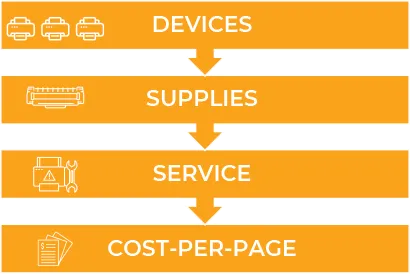
SUCCESS = DEVICE UPTIME
Reactive. Transactional. Device Focused.
SmartPrint360 Framework
Governance-Centric
FOCUS: Governance, visibility, and operational control
OPERATING MODEL: Proactive governance framework
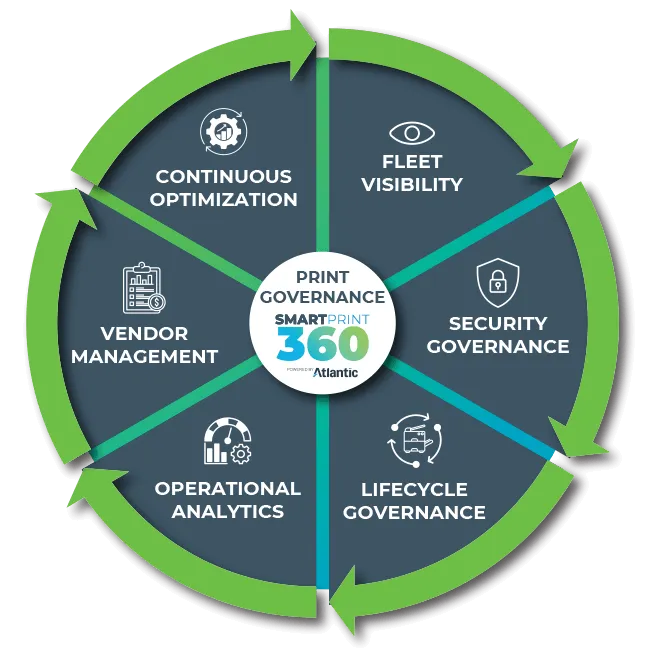
SmartPrint360 combines six critical governance disciplines into a single operational model
SUCCESS = BUSINESS OUTCOMES
Visible. Secure. Optimized. Governed.
Traditional MPS Answers:
Is the device working?
Has toner been delivered?
Was the service call completed?
SmartPrint360 Also Answers:
Why do we own this device?
Is it aligned with standards?
Does it create security risk?
Is it properly utilized?
Should it be replaced?
Can it be consolidated?
What is the business impact?
Who owns accountability?
The Challenges Governance Solves
Most enterprise print environments were never intentionally designed. They evolved over years of office expansions, departmental decisions, vendor changes, acquisitions, remote work shifts, and reactive support models.
As a result, print infrastructure often operates outside the governance standards applied to the rest of the modern IT environment.
The issue is no longer simply about devices or print volume.

SmartPrint360 helps organizations progress from reactive print management to optimized print governance.
What Is SmartPrint360?
Over time, printers, multifunction devices, contracts, vendors, support processes, security configurations, and purchasing decisions evolve independently across offices, departments, and business units. What begins as a simple print environment often becomes fragmented, difficult to manage, and increasingly disconnected from broader IT governance standards.
SmartPrint360 is an Enterprise Print Governance Framework designed to help organizations bring visibility, accountability, security, and operational control to their print infrastructure.
Rather than focusing solely on devices, service calls, supplies, or cost-per-page agreements, SmartPrint360 provides a structured approach to governing the entire print ecosystem.
SmartPrint360 Governance Framework

Visibility
Understand what exists across the environment, where it is located, how it is being used, and whether it aligns with organizational standards.

Security
Identify print-related risks, improve device security posture, support compliance initiatives, and establish consistent security standards across the fleet.

Lifecycle Management
Align refresh decisions with business objectives, eliminate unsupported devices, reduce technical debt, and create long-term planning strategies.

Operational Performance
Reduce IT burden, improve support consistency, streamline vendor management, and eliminate recurring operational friction.

Financial Accountability
Gain greater visibility into total cost of ownership, utilization patterns, contract overlap, and opportunities for optimization.

Continuous Improvement
Establish ongoing governance processes that allow the environment to evolve alongside organizational growth, technology changes, and business priorities.
Traditional MPS Maintains Devices.
SmartPrint360 Governs The Environment.

Traditional MPS Measures:
Traditional MPS focuses on the operational metrics required to maintain devices, deliver supplies, and support day-to-day printing.
Meter Reads
Toner Usage
Service Calls
Device Uptime
SmartPrint360 Measures:
SmartPrint360 measures everything traditional MPS measures, plus the governance, security, lifecycle, and operational metrics required to continuously improve the environment.
Governance Maturity
Security Exposure
Lifecycle Risk
Fleet Visibility
Device Utilization
Standardization Compliance
Vendor Performance
Operational Efficiency
Cost Optimization Opportunities
User Experience Trends
Together, these disciplines create a more secure, efficient, and manageable print environment that supports both IT objectives and business outcomes.
The SmartPrint360 Assessment
Most organizations don't know the true current state of their print environment.
The SmartPrint360 Assessment provides a structured evaluation of your entire print infrastructure across governance, security, lifecycle management, utilization, operational performance, and financial alignment.

What We Evaluate
Fleet Visibility
Security Posture
Device Lifecycle Risk
Utilization & Optimization
Vendor & Contract Alignment
Governance Maturity
What You Receive
Executive Findings Report
Governance Scorecard
Risk Analysis
Optimization Roadmap
Recommended Next Steps
More Than Managed Print Services
Traditional Managed Print Services were designed to maintain devices.
SmartPrint360 was designed to govern the environment.
While managed print programs typically focus on supplies, service, and device uptime, SmartPrint360 focuses on the broader operational questions that IT leaders, security teams, finance departments, and executive stakeholders are increasingly being asked to answer:
Do we know what exists across the environment?
Are devices aligned with security standards?
Which assets present operational risk?
Are we managing lifecycle proactively or reactively?
Where are costs being created?
Who owns accountability for optimization?
How do we measure improvement over time?
These are governance questions, not hardware questions.
And they require a governance-based approach.
© Copyright 2026 SmartPrint360-All rights reserved.